
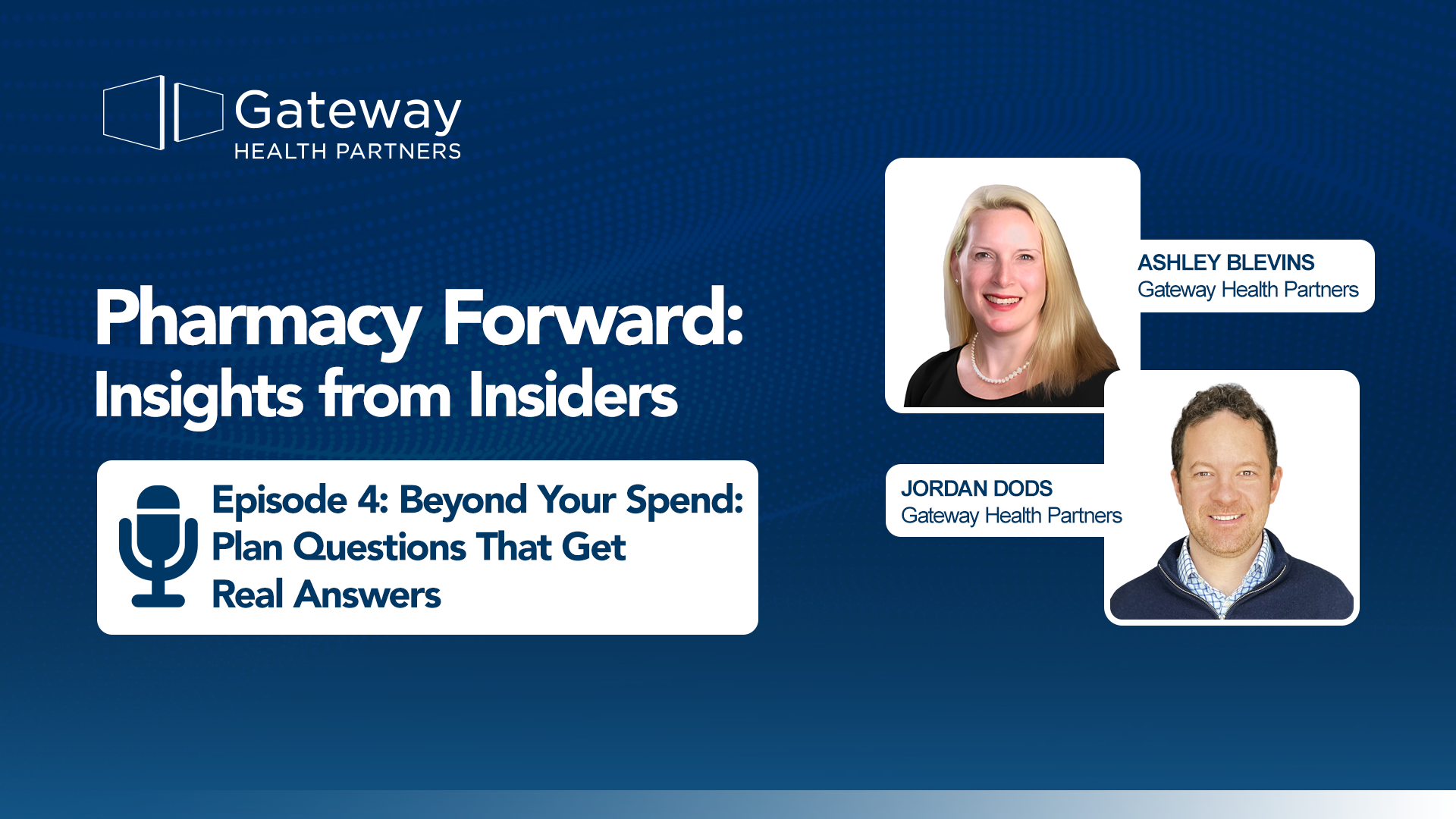
Pharmacy Forward Podcast, Episode 4
Welcome to Episode 4 of Pharmacy Forward featuring Ashley Blevins, Senior Vice President, Client Services, and Jordan Dods, Vice President of Business Optimization.
Join our host Lesley Pink as she and our guests as they walk through the questions plan sponsors should bring to their pharmacy and rebate partners, and how to judge the answers they get back.
The takeaway: know what you’re solving for and expect answers that stay consistent from the spreadsheet to the conference room.
Listen Now
Episode Transcript
Beyond Your Spend: Plan Questions That Get Real Answers
Lesley
Hello and welcome to Pharmacy Forward, Insights from Insiders. I’m Lesley Pink, your host. Rebate strategy is a hot topic. Today we’ll be talking about the questions you should be asking your pharmacy partner about their rebate strategy. We’ll talk with two people from Gateway Health Partners, Ashley Blevins, senior vice president, client services, and Jordan Dods, vice president of business optimization.
Ashley has been with Gateway since November 2025, and Jordan has been with the company for almost two years. Welcome to the podcast, Ashley and Jordan.
Ashley
Thank you, Lesley, for having us.
Jordan
Great to be here.
Lesley
Can you both tell us a little bit about your background?
Ashley
Sure. Ladies first, right? I have been in the healthcare industry going on 23 years. Most of that has been in the PBM space, although I’ve also had some stints on the adjudication platform side as well as client operations. And then as you mentioned, I just started with Gateway almost a year ago, and I’m joining the rebate niche space. So excited to be here. Thank you.
Jordan
And a little on my background, Lesley. I’ve been in healthcare for over 15 years now, both on the management consulting side with McKinsey for a long time as well as working on provider side businesses, specifically with dentists, and have been in the PBM and rebate space for almost four years now.
Lesley
Great, thank you. Now we can get into some questions. Most plan sponsors ask their partner some version of the question, what did we spend? But what is the more revealing question that they are not asking?
Ashley
I can take a stab at this one first. I think that’s a good question, right? All of our clients have budgets and needs and goals and objectives that they need to hit as it relates to their healthcare spend.
But I think the number one question that the plans need to be asking is really digging into their data and their trends. That’s something that Gateway has spent a lot of time and energy and focus on the past couple of months, making sure that we’re reviewing data, looking at data and bringing that to our clients with the goal of a partnership in mind. So it’s definitely looking at trends.
But acting on data and analytics and then going back to our partners to tell them how we can work together to solve for some of their budget problems, you name it. We can do that with data.
Lesley
Why do so many plan sponsors not know what to ask? Is it because the questions are hard or because the industry has trained them to accept the report that they were handed?
Jordan
I think the game has changed.
If you look at everything that’s happened in the last five years, whether it’s with the IRA or the CAA or GLP-1s, I can come up with any three-letter acronym you want. It really has shifted the market, and it’s made it really, really hard for plans and employers to keep up. On top of this, the rising cost of benefits, whether it’s medical or pharmacy for employees, is crazy and quite frankly a little overwhelming. And so, I don’t know if it’s as much that they’ve been trained to think a particular way.
It’s just that historically, at least with pharmacy benefit, with your rebate partner, you had someone that you sent claims to and they sent you a check every quarter. That’s no longer enough and no longer sufficient. So it’s really a re-education and an evolution of the space and of the market, and it’s time for employers and plans to really have tougher and much more in-depth conversations with their rebate partners to figure out how to adapt and survive and thrive in this new world.
Lesley
What separates a question that gets a real answer from one that just gets a nicer looking chart?
Ashley
I can take this one. I think it’s a deeper understanding of the relationship that we have with the client. As Jordan mentioned, this space is exponentially more complicated. It used to be very transactional, right? You send us a claims file, we send you a check, and you rinse and repeat every quarter. Now we’re asked to provide more context, be more consultative. And to that end, Gateway has spent a lot of time and effort over the past nine months revisiting and retooling our service model, looking at the tools that we provide clients and really just elevating every facet of our client management operation to fit into this new world that we’re living in.
Jordan
And I’ll add to that. Ashley said a key word there. We used to be a transactional partner, more like a vendor, your rebate vendor. You really need someone that can be a partner and can work alongside you and help you figure out, honestly, what questions and what goals you are trying to solve. It’s no longer necessarily just about maximizing the rebate check. It could be about plan design or benefit design or cash flow. And the better that a client can understand that question and have a partner that can help deliver, in our experience, that makes everyone a lot, lot happier.
Lesley
Now let’s get into some financial questions. On the financial side, what’s the first question that a plan sponsor should ask that they usually don’t ask?
Ashley
I would say it’s around some of those acronyms that Jordan alluded to earlier, particularly IRA. 2026 and 2027 is where we’re going to see some significant hits due to this policy. And so, we’ve been trying to be proactive about it, working with clients to identify their risk, because depending on the client type, it hits differently for every client. So I think first and foremost is IRA. And then probably second to that would be CAA, which is that federal legislation for 2029. I would say those are the two areas that hit the hardest.
Lesley
When a partner reports savings or guarantees, what should the client push on to know whether those numbers are real and durable?
Ashley
I can certainly take this. I think with the right partner, they’re going to know that going in, right? Our goal is to be transparent. That’s been our philosophy for a while, and we’re certainly not running from that as we head into this new chapter. But we are very big with clients on working with them so they’re not just going to get a check and not understand how they got there. We’re going to work with them on reporting, we’re going to work with them to understand the IRA, the biosimilars and other things that may be hitting their data and hitting their rebates, but they’re going to hopefully know that before that check comes through. So I would say there it’s really the focus on transparency and moving into a proactive stance with our clients versus the reactive position that a client may have somewhere else. That’s been a very big focus of ours at Gateway, that transparency.
Jordan
Yeah.
Lesley
How much has the answer changed upon initial review of data and then the final meeting?
Jordan
Yeah, that’s a really good and important question. A lot of times, let’s say Gateway is invited to be one of the three finalists. One of the things that we hear from prospects before they become clients is that some of our competitors will significantly change the value that they offer. It comes out at, let’s call it, a hundred, but by the time they get to the final meeting or final BAFO, it’s 130.
And so for us, that’s interesting. If you have someone who, to a lot of what Ashley was speaking to, really understands your business, really understands the problems that you are trying to solve, and really is good at data and understanding what potential value could be there, the answer should probably be the same throughout. Now, sometimes the final number does change because you’re designing formularies or adjusting benefit plans in different ways. That’s all well and good if it’s explainable, but if with the BAFO, magically the original number that got them to the final table increases or shifts dramatically, it’s a good time to ask a lot of questions and understand just what’s driving that. Because oftentimes you’ll see that folks out there may not be as transparent as they probably could be in order to win your business.
Lesley
And let’s talk a little bit about the clinical side. On the clinical side, what should a plan sponsor be asking about why a drug is on their formulary and who benefits from it being there?
Ashley
Yeah, I think this is a great question as well because formulary management is really the key to what that rebate check is ultimately going to look like. So first and foremost, it’s about understanding the client’s goals and objectives. If we understand what they’re trying to accomplish, it’s definitely something that we can partner on internally with our clinical subject matter experts, of which we have a fantastic team of clinicians and clinical operators that work in this formulary space all day. But the fact of the matter is the number of drugs paying a rebate isn’t as high as it was maybe 10 years ago. So there’s definitely strategy involved. And we welcome that conversation and that strategic partnership so that clients at the end of the day can accomplish their goals and objectives.
Lesley
What is a question that surfaces when a clinical program is actually working versus just existing on paper?
Ashley
I think really the consumer will tell you, right? As healthcare becomes more of a consumer focus, if it’s working, your members will go there. Whether that’s a weight loss management program or an asthma program or something designed for a specific disease state that is somewhat prevalent in a client population, if it’s working and it has good outcomes, people will sign up for it. Over the last 10 or 15 years, with that change in healthcare consumerism and websites and apps, people have become more engaged. They’re also paying more out of pocket than they ever have. So if it’s out there, they will come. And I think that the membership does the talking.
Jordan
It is exactly this, and it’s exactly how the industry shifted so much in the last five years, whether it’s the GLP-1s or the biosimilars that have come on market. What your rebate partner should be doing is providing you with more than just a check. You need clinical solutions, you need the detailed reporting, you need the tools that you can actually control this and understand what’s happening, because it’s more than just a dollar amount now. And the clinical side is an incredibly important component to delivering the best benefit to your employees at a cost and a value that’s reasonable.
Lesley
What’s a fair question a plan sponsor should be able to ask that tends to make other partners uncomfortable and why?
Ashley
I would just go back to IRA first and foremost because, as Jordan alluded to earlier as well, these bids can come in a lot of different forms and so you have to be very crystal clear about your numbers, maybe provide numbers with IRA impact and without IRA impact so that plans have an apples-to-apples comparison of what these offers are. It’s difficult sometimes to weed through that. So IRA right now, at least in the near term, is making that noise. I would say in the longer term, a 12- to 18-month outlook, the CAA readiness is something that can probably make a lot of folks uncomfortable. And I will say that at Gateway, I think we’re really ahead of that. We work very closely with our legal team.
We’re looking to put solutions at our clients’ fingertips and give them access to things that really drive that full transparency.
Lesley
If a plan sponsor asks their current partner one of these questions and gets a vague answer, what should that tell them?
Jordan
Vagueness, particularly in this environment, might indicate that that partner may not be as well prepared or as well informed as they may let on, or they may be trying to put lipstick on a pig, quite frankly.
And look, this rebate world is small and because it’s so convoluted and crazy and dynamic, reputations are really important. And so you’ve got to find someone that you trust, that will treat you as a partner openly and honestly.
And I think it helps drive confidence that the partner you’re willing to trust with such an important benefit for your employees and members is the right one.
Lesley
Which of these questions matter most for a smaller self-funded employer, and which are more relevant to a large health plan?
Ashley
I don’t necessarily think the life count matters as much. I think it’s really the type of client. At Gateway, we work with all of the above. And I think it’s just really about tailoring solutions to ultimately meet that client’s goals and objectives, no matter what the life count is. So obviously this is a volume-driven business, more volume equals more yield, but at the end of the day, we’ve got solutions and scope for everything, and I think we’re a good partner no matter the size of the client.
Jordan
Yeah, it really comes down to just understanding what problem the client is trying to solve. There are a number of solutions that can be adjusted and accommodated to meet someone with 10,000 members to someone with hundreds of thousands of members.
Lesley
And is there a question every plan sponsor, regardless of size, should be asking at least once a year?
Jordan
Are we ready for IRA? What’s the IRA impact for next year? Are we CAA compliant? Are we going to be on our reporting? I know that’s three questions, but you can learn a lot from your potential partner just by asking all three.
Ashley
And I would add to that, particularly as it relates to the mandates, we’ve obviously seen a lot of federal and state legislation around pharmacy.
I’m young enough to remember that this used to only be on paper, right? There were ways that you had to report things. It now impacts adjudication. So we’ve heard from clients that the growth in their PBM is coming from their compliance department. They’re not able to hire more account managers or customer service representatives. They’re hiring compliance folks because of how complicated it’s getting. So I think that’s a real opportunity for Gateway in a space that we’re already very comfortable in, and I look forward to sharing more and more around our knowledge in that area.
Lesley
If a benefits leader could only ask three new questions at their next business review, what should those questions be?
Ashley
I’m always of the opinion for C-suite folks that if I were sitting in that chair, I would want to make sure that I understood my trend, my trend relative to the peers in my group. So what are the peers doing and are they experiencing the same trend? I would also ask, am I in compliance with my agreement? Every agreement and contract has commitments and deliverables, and you want your vendor to be showing up, demonstrating and reporting out on those deliverables. And then, what would you recommend? As the subject matter experts in the room, I want to hear your best ideas. Those are the three things that I think anybody at the C-suite level should be asking on a regular basis.
Jordan
Yeah, I agree. And if you were given three more, I’d say, are we ready for IRA? Are we ready for CAA? What are we doing with the GLP-1s?
Lesley
And beyond the questions themselves, how should a plan sponsor judge the quality of the answer they get back?
Ashley
I think, from the way I answered that question, it’s consistency, right? Ideally,
Jordan
Yeah, agree.
Ashley
we’re sitting down with clients on a regular basis, and every time we have the opportunity to meet with them, we’re going to be demonstrating what I talked about: trend, commitment to the deliverables, adherence to the contract, and good recommendations. So I think those are the cornerstone of a solid account management team, and that’s certainly what I’m tasking my folks to do.
Jordan
A hundred percent. And exactly to what Ashley said in terms of consistency, make sure there’s consistency between the written answer, the analytical answer of the spreadsheet, and what the folks in the room or on the call can actually speak to. There’s so much AI-infused stuff right now that you really need to be careful to make sure that you are partnering and talking with someone that actually knows what they’re talking about and isn’t just really good at prompting some LLM.
Lesley
What is the single question that if plan sponsors started asking it tomorrow would change the most about how they manage their pharmacy benefit?
Ashley
Again, I think this comes down to what their goals and objectives are. We now have low net cost formularies, rebate-driven formularies, things in between, GLP-1 programs, all of the above, right? Depending on even the population within your various plans. So I think it’s just a matter of understanding what those needs are first.
And maybe there is a need to pivot to another solution.
Maybe there’s a way that we can build a bridge to get from a higher yield formulary to a lower net cost formulary by building little stages and approaching it that way. I think that’s what Gateway delivers in a nutshell, different solutions depending on the client’s needs and objectives. And so we’re there to partner in any way that we can to ensure that they’re meeting their mark.
Lesley
Jordan, do you have anything to add to that or you’re good?
Jordan
Yeah, I’m going to sound like a broken record, but what are you solving for? And then again, are you ready for the three letter acronyms? IRA, CAA, GLP-1s.
Lesley
Great. Thank you, Ashley and Jordan, for joining us for the fall episode of Pharmacy Forward. Remember that you can find us on Apple Podcasts, Spotify, and YouTube.
Ashley
About Pharmacy Forward: Insights from Insiders
Are you looking to stay ahead of breaking news, trends, and resources related to the pharmacy market and drug pricing? Tune in to Gateway Health Partners’ podcast, Pharmacy Forward: Insights from Insiders, a quarterly podcast featuring pharmacy experts who have the inside scoop on the pharmacy market, drug costs, and clinical hot topics.